EN
EN  ID
ID 



Are you a small business owner looking for the best way to manage your fleet? You may feel that everything is already under control and that there is no need to look for solutions to current fleet management challenges. However, one thing small business owners should always remember is—to always think big.
What is a small business?
A small business is typically a privately held corporation, partnership, or sole proprietorship with a small number of employees and lower revenues than a regular-sized business. Small businesses can come in many forms and operate in a variety of industries, including restaurants, bakeries, plumbing services, construction, online retail, or boutiques.
What Is Fleet Management?
Fleet management is a general term for all the activities and processes that are essential to running a fleet efficiently.
A fleet can consist of buses, trucks, or other commercial vehicles used for business purposes. The primary goal of fleet management is not only to simplify the driver's work but also to simplify the responsibilities of a fleet manager.
What are the responsibilities of a fleet manager in a small business?
Fleet managers have several fleet responsibilities on their shoulders, including:
- Driver management: Fleet managers are responsible for supervising drivers' behaviour and operations, as well as providing them with necessary training.
- Documentation and record keeping: The fleet manager is responsible for maintaining accurate fleet records and documentation, including maintenance and inspection documents.
- Fuel management: Fleet managers are responsible for ensuring their fleet remains fuel efficient by monitoring fuel consumption and identifying fuel waste.
- Maintenance and repair: Fleet managers are responsible for keeping vehicles in good condition by scheduling regular vehicle inspections and maintenance.
- Cost management: Fleet managers are responsible for monitoring and optimising all fleet-related costs, from fuel consumption to vehicle usage, to increase their return on investment.
As a fleet manager, this can be a lot of work, especially when dealing with the fleet challenges faced by small businesses. Let's take a look at these challenges.
What are some of the fleet challenges that small businesses typically face?
Because of their size, small businesses face a unique set of challenges that can significantly impact their growth and success. The most common include:
- Limited resources: Because small businesses don't have large fleets of vehicles, completing all their tasks effectively, especially when demand is high, can be quite challenging. This increases the likelihood of equipment wear and tear due to overuse, leading to increased maintenance costs.
- Unexpected repair and maintenance costs: Due to limited financial resources, small businesses cannot afford unexpected repair and maintenance costs, which strain their financial resources. These unforeseen, unbudgeted costs can also cause vehicles to stop operating.
- Unplanned vehicle downtime: Unplanned vehicle downtime is a problem for any business, but it's especially detrimental for small businesses. Small businesses typically don't have large fleets of vehicles, so unplanned vehicle downtime can significantly impact their productivity, revenue, and customer reputation.
- Track and manage vehicles and drivers effectively: Small businesses may not have the same time, expertise, and resources as larger businesses, making it difficult for fleet managers to stay on top of where their drivers and vehicles are and how they are being operated.
- Driver safety concerns: Ensuring drivers operate safely is a primary concern for all businesses, but because smaller businesses typically lack the resources to invest in robust driver monitoring systems, this can pose a greater challenge to the overall safety of their fleets and drivers. It also increases risks and impacts their fleet's fuel efficiency.
- Fuel costs: Fuel costs can be a significant expense for small businesses, especially when not carefully monitored. Consistently high fuel consumption can negatively impact a small business's bottom line and profitability.
- High driver turnover rate: Because small businesses don't have large budgets, they may struggle to compete with the competitive packages offered by larger businesses. This means managers need to find ways to keep drivers happy and loyal, which can be quite a challenge.
These challenges may seem daunting, but there may be a simple, accessible, and affordable solution that can help address them all: a fleet management system.
What are the benefits of using fleet management software?
Essentially, fleet management plays a crucial role in running a fleet successfully and efficiently. Fleet management software simplifies all tasks involved in fleet management, providing the following benefits:
- Improve route planning: Route planning is crucial for successful fleet operations because it has a significant impact on operational efficiency, cost savings, and customer satisfaction. Fleet management software can help fleet managers create efficient and economical routes by taking into account factors such as the shortest possible route, traffic conditions, and vehicle capabilities. Efficient route planning reduces fuel consumption and vehicle wear and tear, leading to lower operating costs. Poorly defined routes mean unnecessary miles traveled for even the simplest tasks, which increases fuel consumption and vehicle wear and tear. By optimising routes, reducing mileage, and cutting costs, businesses can save time and money.
- Helps reduce fleet costs: One of the key benefits of fleet management software is the unparalleled fleet visibility it helps unlock. With greater visibility into drivers, vehicle conditions, fuel consumption, and cargo safety, fleet managers can gain better control over their fleet costs. By providing features like fuel monitoring, route optimisation, and preventative maintenance, fleet management software is crucial in helping fleets reduce their operating costs.
- Improve customer satisfaction: Customer satisfaction is crucial to success, especially for small businesses. By providing real-time tracking and visibility into their fleet, fleet managers can inform their customers about the progress of their deliveries with accurate estimated times of arrival (ETAs). Drivers are a crucial aspect of a fleet, so by improving safety and compliance through driver behaviour monitoring, managers can not only ensure their drivers are not engaging in activities that could jeopardise the fleet's success but also ensure that goods are delivered without damage. With maintenance schedules, they can ensure that their goods or services are delivered with minimal or no delays.
- Improve and extend vehicle health: Vehicle health and longevity are critical to success, especially for small businesses with limited vehicles and the ability to replace them frequently. Fleet management software provides access to preventative maintenance, which helps detect vehicle failures quickly before they worsen and impact fleet efficiency and driver safety. This helps fleets prevent unplanned vehicle downtime, which can cause costly delays and lower customer satisfaction. Asset utilisation helps fleet managers identify which vehicles or equipment are overutilised, helping them distribute the workload equitably and avoid placing unnecessary stress on certain vehicles/equipment.
- Driving data-driven decision making: Managers need to ensure that all fleet decisions are driven by data. Fleet management software provides access to insights for action through data analysis and analytics, helping to make more informed decisions for the fleet.
- Simplifying remote management: Small businesses need to make the most of their limited resources. By gaining efficient visibility into vehicles and drivers from anywhere and at any time, remote management helps fleet managers stay connected with their drivers and provides support through 24/7 driver and job analytics, which can improve operational efficiency and overall safety.

How can fleet management software help address the challenges faced by small businesses?
The goal of fleet management software is to simplify the various tasks essential for effective fleet management. Here are four ways this software can make this possible:
- GPS vehicle tracking: Real-time vehicle tracking in fleet management involves the use of GPS and telematics technology to monitor vehicle location, movement, and behaviour in real time. GPS trackers enable fleet managers to improve operational efficiency, ensure driver safety, optimise vehicle performance, and reduce operating costs. By implementing real-time fleet tracking, fleet managers can make data-driven decisions. This technology offers the following benefits:
– Real-time vehicle visibility: By providing continuous live updates, GPS tracking makes it easy for fleet managers to know exactly where each vehicle in their fleet is at any given time.
– Prevent unauthorised use of vehicles: By providing insight into how vehicles are operated, fleet managers can quickly see whether their drivers are using fleet vehicles for personal use rather than assigned tasks. - Maintenance scheduling and notification: Fleet maintenance scheduling and notifications involve using technology to track and manage all maintenance-related activities for vehicles and equipment. By utilising real-time notifications and reminders, fleet managers adopt a proactive approach to maintenance scheduling, allowing fleet vehicle maintenance to remain under control. The benefits include:
– Lower repair costs: By sending notifications immediately when a problem is detected, maintenance notification technology helps prevent maintenance issues before they become more severe and expensive to fix.
– Extending the life of fleet vehicles: By automating the scheduling of routine vehicle inspections and servicing, this technology helps extend the life of a fleet by keeping vehicles operating at their best and preventing costly repairs and replacements.
– Maintaining fleet compliance: By tracking maintenance records and ensuring all issues are addressed promptly, maintenance scheduling technology helps ensure that fleet vehicles consistently meet legal and regulatory standards while in operation. - Fuel management: Fuel management in the context of fleets refers to the process of monitoring and controlling a fleet's fuel consumption. A fuel management system uses telematics to measure fleet vehicle usage, and by offering automated software for monitoring, controlling, and optimising fuel usage, it automates previously time-consuming fuel tracking. A fuel management system is important because it helps fleets:
– Prevent fuel theft: By providing fleet managers with real-time fuel capacity monitoring, fuel management systems help managers quickly spot potential fuel theft, from fuel card siphoning and fraud to fuel card cloning.
– Reducing human error: By automating fuel monitoring, errors caused by human input are eliminated, ensuring accurate vehicle and driver data. As a fleet manager, you can now say goodbye to manual data entry, which often leads to inaccuracies that harm overall fleet efficiency.
– Improving driver behaviour: By identifying and eliminating fuel-wasting driver behaviours, fleet managers can ensure their fleets remain fuel-efficient. -
Driver Monitoring: Driver behaviour monitoring works to continuously assess and analyse driver behaviour and actions while they're behind the wheel. This is accomplished by utilising a combination of cameras, sensors, and GPS vehicle tracking. The system uses a baseline of normal driver behaviour and can provide real-time alerts when deviations from this behaviour are detected. Whether it's drowsiness, signs of fatigue, or distracted driving, this technology helps drivers correct these behaviours in real time, resulting in the following benefits:
– Reducing distracted driving: By detecting signs of distracted driving, such as frequently looking away from the road, the software alerts drivers to focus, ultimately reducing the chances of accidents caused by distracted driving.
– Reduce fatigue: By detecting signs of driver fatigue, such as frequent yawning, the software alerts drivers that it may be time for them to take a break, ultimately reducing the chances of road accidents caused by tired drivers.
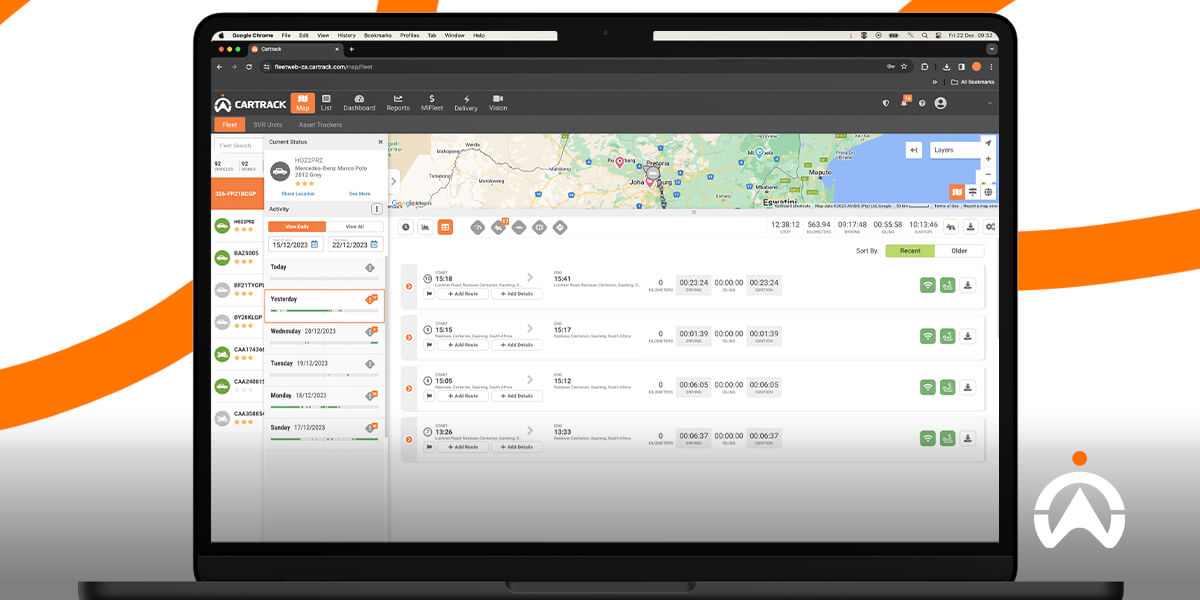
Improve efficiency in your business, whether small or large, with advanced fleet management software from Cartrack.
Cartrack's fleet management system provides access to a variety of software tools to meet every fleet need and help overcome potential challenges. Here are nine ways Cartrack helps small businesses improve:
- AI Live Vision Camera: Unlock real-time alerts about dangerous or distracted driving behavior with Cartrack's AI Live Vision camera. Our software uses an in-cabin camera and artificial intelligence analysis to provide real-time driver behaviour alerts. When dangerous driving behaviours like excessive speeding, yawning, mobile phone use, and smoking are detected, an in-cabin voice alert immediately alerts the driver so they can correct their behaviour in real time. You can also receive real-time alerts and access recordings via a livestream feed.
- GPS vehicle tracking: Accurately track the location of your fleet vehicles in real-time with live GPS tracking from Cartrack. As a small business, you can use the data collected from GPS tracking to monitor and improve overall fleet performance. Real-time GPS tracking also provides access to enhanced security and safety.
- Geofencing: Monitor where your vehicles or equipment are operating with Cartrack's geofencing feature. This software allows us to set up virtual boundaries around specific areas to monitor the movement of drivers, vehicles, and equipment. Once a geofence is set up, we can receive alerts immediately when a vehicle enters or exits a specified area, providing real-time visibility into fleet activity.
- Cargo Monitoring: Keep your fleet's cargo safe with Cartrack's cargo monitoring solution. Working as part of our AI-powered SmartCabin system, our cargo cameras provide unparalleled visibility into the cargo being transported. The software allows for easy cargo monitoring from four cameras live streaming, and the footage can also be downloaded instantly. Cartrack's cargo door sensors also provide real-time alerts as soon as the cargo door is opened.
- Vehicle Maintenance: Keep your fleet vehicles running optimally with preventative vehicle maintenance from Cartrack. Powered by artificial intelligence and advanced analytics, our preventative maintenance software analyses vehicle performance and detects potential maintenance issues before they become dangerous and costly. Receive alerts about issues like faulty brakes, low water and oil levels, service interval reminders, and more to anticipate and avoid costly breakdowns, road accidents, and further damage to your vehicles, and create effective maintenance plans.
- Fuel Monitoring: Keep track of every litre of fuel with Cartrack's fuel monitoring system. Our fuel cost monitoring software reviews fuel transactions, matches fuel receipts with advanced vehicle telemetry, and provides real-time visibility into fuel usage. Using fuel sensors installed in vehicle tanks, you can closely monitor how much fuel your vehicle is consuming. This system is essential for reducing fuel waste, identifying fuel theft, and improving fleet fuel efficiency.
- Route Optimisation: Determine the fastest and safest routes for fleet drivers with Cartrack's route optimisation feature. Accessible through our Deliveries app, this feature provides real-time alerts on route deviations and delays, helping ensure fast delivery turnaround times and improving customer service. You can also easily view driver status, allowing you to quickly assign tasks to the nearest available driver.
- MiFleet: Know your fleet's exact operating costs with Cartrack's MiFleet software. Whether you have one vehicle or hundreds of vehicles, you need to effectively manage your fleet's finances. MiFleet is a vehicle cost management software that helps fleet managers track their fleet expenses, from taxes and vehicle permits to finance and fuel costs. By providing in-depth insights into your fleet's expenses, you can unlock potential savings on fuel and larger costs, such as administrative costs.
Interested in using a fleet management system for your business? Contact Cartrack by clicking the link below!