Struggling to Manage Your Fleet? Boost Performance with MiFleet

If you're a fleet owner, you might be wondering how productively your assets are being utilised. MiFleet, fleet accounting software integrated with Cartrack Fleet Web, helps you evaluate your fleet and optimise your business's profits. Here are three ways to do it.

1. Measure the Level of Vehicle Usage

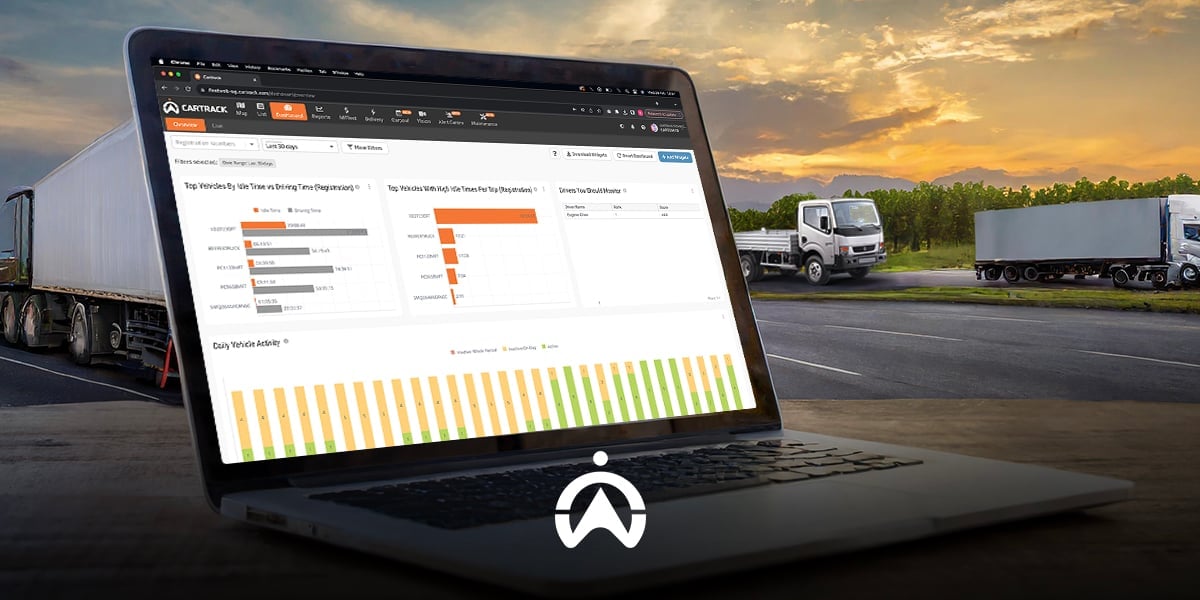
Through the "Charts Dashboard" menu, you can view a comparison chart of your fleet's mileage. You'll see whether all vehicles are being used equally, whether they're achieving productive mileage, and whether they're being used most frequently and least frequently. This information allows you to further analyse the usage of each asset.

2. Vehicle Fleet Cost Analysis

On MiFleet, you enter all costs incurred per vehicle, such as insurance, vehicle loans, service and maintenance, taxes, damage, replacement parts, tolls, traffic tickets, etc. After that, you can view a list of all vehicles, each with its total monthly and annual costs, via the "Fleet Status" menu. For further analysis, you can go to the "Reports" menu, which provides several automatic reports, such as vehicle costs per km, costs per trip, and costs per driver.

Manajer armada kendaraan memegang laptop di depan truk logistik untuk optimasi bisnis menggunakan MiFLEET.

3. Optimise Fleet Business and Profit

Analysis of asset usage and fleet costs helps you evaluate vehicles, drivers and trips in terms of business profitability. This way, you can decide whether you need to reduce the number of vehicles and drivers, or reorganise your asset usage system. Various strategic considerations based on data processed by MiFleet are certainly able to make the fleet business more optimal and increase profits.

Study and re-evaluate your fleet's operating costs with MiFleet, transforming data into more informative and effective tools. Identify profitable and less profitable vehicles, drivers, and jobs, and optimise your business's bottom line! Get a FREE DEMO of MiFleet from Cartrack now!

6 Things to Consider When Choosing a GPS Tracker

Growing public interest in vehicle monitoring has led to the expansion of the GPS tracker business. A wide range of vehicle monitoring devices—both local and imported—is available on the market, each offering its own unique advantages. How can you choose the best option from among the many available GPS tracker brands? Consider these six factors when evaluating a GPS tracker!

1. Complete Features According to Needs

Not only able to track vehicle location, GPS tracker features are increasingly varied. Some of them include fuel monitoring, driving behavior monitoring, vehicle engine monitoring (on/off), remote engine shutdown, cargo door sensors, emergency buttons (SOS), and geofences. Do you just want location monitoring, or more? Look for one that suits your fleet monitoring needs and make sure the monitoring system (via PC/mobile) is easy to understand and use.

2. Have an Official Permit and Postel Certificate

The GPS tracker company you choose must have an official permit and Postel certification from the Ministry of Communication and Information Technology to trade its products in Indonesia. This is very important, because if it is not there, the risk of being blocked is quite high because it entered Indonesia illegally, so you will suffer losses. This Postel certificate is valid for every model/type of GPS tracker device used, with a validity period of 3 years and can be extended.

3. Hardware and Software Developed in-house

Many GPS tracker companies actually only offer installation services, while sourcing the devices from external suppliers. If multiple companies source from the same place, what sets them apart? The difference often lies solely in the quality of their technicians and their software (whether developed in-house or by a third party). Opt for a company that develops its own hardware and software; this offers greater peace of mind, knowing that the company you trust fully understands the ins and outs of its products.

Hand holding a modern black GPS tracker device with cables in front of a white wall for vehicle tracking system.

4. Data Storage Not from Third Parties

The server plays a crucial role as it is the center of data and traffic. It is highly discouraged to choose a GPS tracker with a rented server from a hosting provider, especially one that relies on free hosting. Data storage quotas for GPS trackers that do not have their own servers are usually very minimal, and access is slower. This is because rented or free servers handle a wide variety of data and users, not focused solely on the GPS tracker, and their traffic is also high.

5. There is After Sales Service and Warranty

Make sure the GPS tracker company you choose has after-sales customer service and product warranty. You don't need to bother spending a lot of time repairing the device when it is damaged or has problems. With after-sales service and warranty, complaints can be handled and device damage can be repaired immediately by technicians provided by the GPS tracker company. Because a GPS tracker is a long-term investment, you also need to assess the company's existence. Customer service support and warranty will be useless if the company goes out of business.

6. Can Trial Products and Free Training

To ensure that your GPS tracker is as good as advertised, you should test it first. This test run is very useful, especially if you intend to use it in a large fleet with complex features. Don't be disappointed if the GPS tracker and its various features don't work properly after installation. Additionally, you should also check if free training is available. This will be especially useful if you are using a GPS tracker with many features and have several operational managers monitoring your fleet.

Don’t have much time to look for a GPS tracker that meets all six of the criteria above? Don’t worry, Cartrack is the solution!

Cartrack has obtained official permits and Postel certificates for the types of GPS trackers used. We have a variety of features that can be tailored to your fleet monitoring needs. The hardware and software are developed by Cartrack's internal team, with an internal server center. We provide a lifetime warranty, 24-hour customer service, free training, and product trials.

Cartrack has everything you need—what are you waiting for? Contact us right now and get a FREE DEMO of Cartrack!

5 Fleet Management Challenges and Solutions

Efficiency is paramount in fleet management. Unfortunately, most fleet managers are overwhelmed by time-consuming tasks that don't significantly increase profits. Furthermore, fleet managers lack comprehensive monitoring capabilities, making it difficult to maximise fleet operations. Therefore, digital solutions, such as GPS trackers, are needed to address these fleet management challenges.

1. Large Production for Fuel

It is not easy to predict fuel costs due to the variable nature of vehicle activity—such as monthly mileage and operational duration. Even different drivers can lead to variations in fuel consumption. Fuel expenses sometimes exceed projections, presenting a distinct challenge for fleet managers in identifying the causes and finding ways to improve efficiency.

Solution:

Driving Behavior and Fuel Monitoring

Fuel expenses that exceed projections can be caused by several factors, such as frequent speeding, the habit of leaving the engine running while the vehicle is parked (idling), fuel theft, and fraudulent fuel claims. Therefore, monitoring through real-time notifications is necessary when drivers speed, vehicles idle, and fuel is stolen. You also need accurate monitoring of fuel volume and refuelling locations to compare against claim reports. A GPS tracker with fuel monitoring features accommodates all these functions.

2. Misuse of Company Vehicles

Without a dedicated monitoring system, you can't track ineffective vehicle operation. One example is misuse of vehicles for personal purposes. As a result, work productivity and customer satisfaction decline. Overtime costs also increase due to additional time spent on non-work related matters.

Solution:

Machine and Location Monitoring

To monitor vehicle activity, you need to install a GPS tracker that can track ignition status (ignition on/off) and location. This allows you to know when and where a vehicle is started and switched off. The GPS tracker device can also send real-time notifications for ignition on/off events and usage outside operating hours. More detailed information can be viewed in vehicle trip reports. All of these features can be used to prevent misuse of company vehicles.

Map application view on smartphone for vehicle fleet management solution that monitors the position of delivery trucks on city routes.

3. High Vehicle Maintenance Costs

Have you ever wondered why your fleet vehicles require repairs or part replacements so quickly? Contributing factors include poor driving habits and continuous vehicle usage. Additionally, irregular or careless vehicle maintenance plays a role—even seemingly minor issues like tire pressure.

Solution:

Maintenance Schedule Automation

Eliminate the manual method of recording and remembering each vehicle’s maintenance schedule. By using a GPS tracker, maintenance reminders can be integrated with odometer data and vehicle operating hours. You simply need to set maintenance schedules and reminders based on date, mileage, or operating hours for each vehicle. In addition to schedule automation, you also need monitoring of poor driving behaviour so that corrective and preventive actions can be taken. In this way, vehicles are kept from wearing out too quickly, thereby reducing maintenance costs.

4. Timeliness of Delivery

The inability of field teams to meet established delivery schedules negatively impacts business and company reputation. Dissatisfaction with service can lead to the loss of both existing and potential customers.

Solution:

Geofence and Effective Assignment

For multi-trip operations, you can create a geofence for each delivery destination. Real-time notifications will be sent when a vehicle enters and exits the geofence, allowing you to estimate the vehicle’s arrival time at the next geofence (destination). In addition, you can also make use of the “What’s Nearby” feature if using Cartrack. This feature identifies the vehicle closest to the destination, making assignments more efficient with faster delivery times.

5. Time-consuming administrative work

Managing a fleet of vehicles can be complex and time-consuming, from generating various reports to processing vehicle documents. This manual work reduces operational productivity and is prone to data entry errors and other issues.

Solution:

Automate Reports and Reminders

Data recorded by a GPS tracker can be processed and categorised into various types of reports in PDF or Excel format. These reports can also be automated to be sent at specific intervals via email. You can also track delivery progress and proof of delivery using features within GPS tracker software, such as Communicator from Cartrack. Meanwhile, for managing vehicle and driver documentation, insurance payments, and more, you can use the Reminders feature provided in the GPS tracker software.

Cartrack GPS Tracker provides solutions for the five fleet management challenges mentioned above. We offer a wide range of monitoring features, including those for driving behavior, fuel, engine status, location, vehicle maintenance, geofencing, and task assignment. Contact us now to get a free Cartrack demo!

5 Benefits of a Driver Monitoring System for Company Fleets

Drivers are the frontline of company fleets involved in delivery and transportation operations. Beyond their driving skills, a driver's behavior impacts the company's productivity and operational finances. Therefore, an effective monitoring system is essential to ensure drivers operate safely and productively. Here are five benefits your company fleet can gain from implementing a driver monitoring system.

1. Increase Fuel Efficiency

A monitoring system can detect driving activities that consume fuel inefficiently, allowing you to address and discipline them. Some of these include speeding and unnecessary engine idling, operating the vehicle outside working hours, and deviating from routes, resulting in inefficient journeys.

2. Extend Vehicle Life

Poor driving habits—such as aggressive acceleration, sudden braking, and sharp cornering—lead to accelerated wear and tear on vehicle components. With a driving monitoring system in place, drivers become more accountable for company assets, operating them with greater care. This preserves vehicle quality and extends the vehicle's lifespan.

3. Reduce Overtime Costs

A monitoring system helps your drivers work more productively, thereby reducing excess working hours that would otherwise result in overtime pay. You can compare driver working hours with vehicle operating hours and track unproductive overtime. You can then implement corrective and preventive measures to minimise such unproductive overtime, ultimately lowering overtime wage expenses.

4. Prevent Losses Due to Accidents

Most accidents are caused by driver negligence, such as drowsiness, speeding, sudden braking, and sharp cornering. With a driver monitoring system, you or your fleet operator can receive notifications when a driver commits a safety violation and warn them to exercise greater caution.

5. Increase Company Profits

With more efficient fuel consumption, extended vehicle lifespan, reduced overtime, and the absence of accidents, your company's fleet operating expenses will certainly decrease. You avoid incurring significant costs for repairing damaged vehicles or replacing parts that wear out prematurely, as well as bearing business losses caused by vehicles and drivers being unable to operate due to accidents.

Start monitoring your drivers' driving behavior right now with the Cartrack GPS Tracker! Cartrack’s advanced system detects unsafe driving behavior as well as unauthorized use outside of assignments or operating hours, and sends automated alerts. Contact us and get a FREE DEMO now!