
Integration of CAN Bus Data and GPS Tracker in a Fleet Management System

Not only computers, vehicles also have an internal network called the Controller Area Network or Controller Area Network (CAN) Bus. Like a nervous system connecting different parts of the body, the CAN Bus enables communication between Electronic Control Units or Electronic Control Unit (ECU). These ECUs are essentially the brains of a vehicle’s computerised systems—there are different ECUs that control the engine, air conditioning, transmission, electrics, and more. The CAN Bus extracts data directly from these control units and can facilitate interaction between the various systems within the vehicle.

Accurate Vehicle Information from CAN Bus

The data obtained from the CAN Bus is accurate because it is extracted directly from the vehicle’s system control units. Some types of information that can be obtained from the CAN Bus include seat belt status, doors, odometer readings, fuel levels, and driving behaviour.

Seat Belt Status

The CAN Bus can detect whether the seat belt status of the driver and passengers is active or inactive. Some vehicles can even process this CAN Bus data to take further actions. For example, when the seat belt is fastened, the parking brake may automatically disengage once the driver starts accelerating.

Door Status

The CAN Bus knows when each vehicle door is opened or closed. The CAN Bus can also transmit signals that enable interaction with the electrical lighting system, where the lights can switch on when a door is opened and turn off automatically when the door is closed.

Odometer

The CAN Bus accurately monitors the odometer, allowing you to know the vehicle’s total mileage as well as the distance travelled for each trip.

Fuel

CAN Bus records fuel activity and volume, including refuelling and fuel loss, including fuel consumption.

Driving Behaviour

CAN Bus provides information related to several driving behaviour parameters, such as speeding, idling, acceleration, braking, and cornering.
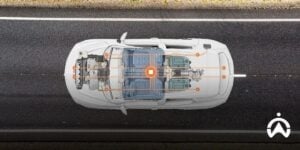
Top view of an electric vehicle showing the integration of CAN bus data into the battery system for optimized fleet management.

CAN Bus Integration with Vehicle GPS Tracking System

These CAN Bus data can be integrated into a fleet management system (fleet management system) based on GPS tracking through an additional CAN Bus clamp feature. This allows CAN Bus data to be displayed on the fleet management software platform. In Fleet Web, Cartrack’s web-based fleet management platform, CAN Bus data is presented in automated reports. You can also set up automatic alerts through the Alerts menu for monitoring CAN Bus data in your vehicles, for example when a seat belt is unfastened, hazard lights are activated, etc.

However, not all vehicle types or brands have a fully comprehensive CAN Bus communication system. Vehicles (passenger cars, buses, or trucks) from brands such as Mercedes-Benz, Volvo, Scania, and other European manufacturers are among those that require a CAN Bus clamp to be integrated with a GPS tracking-based fleet management system. Some vehicle models even require only a CAN Bus clamp (without additional fuel sensors) to monitor fuel consumption within a fleet management system. This is because all electrical systems controlling engine power in these vehicles do not operate in an analog manner.

If you have vehicles with a CAN Bus system, contact us to consult on the implementation of Cartrack’s fleet management system for your vehicles. Our consultants and technical team will provide the best fleet management and monitoring solution based on your vehicle types and requirements.

Book a free consultation now and get a LIVE DEMO to understand how our fleet management platform can support your business!
Besides Location Tracking, Here Are 4 Functions of GPS Trackers for Car Rental Businesses

A GPS tracker is an essential device for companies that rely on vehicle fleets, such as car rental businesses. Known for its ability to track vehicle locations, a GPS tracker also offers other useful functions for car rental business owners. Here are four functions of a GPS tracker beyond location tracking for car rental businesses, without using any additional integrated features or sensors.

1. Anticipating Rental Car Theft

GPS tracking software includes a geofence feature that allows you to mark areas you want to monitor virtually. Geofencing enables you to monitor vehicle activity within these areas and trigger notifications when a vehicle enters or leaves them. For example, if you run a car rental business in Bali and have a policy prohibiting customers from taking cars outside Bali, you can use geofencing to mark the Bali area and ferry ports, such as Gilimanuk and Benoa. This way, you will receive real-time notifications (via e-mail/SMS and mobile app push notifications) when your assets enter a ferry port area or leave Bali. In addition to geofencing, you can also set alerts for usage outside scheduled hours.

2. Monitor the Driving Behaviour of Rental Car Drivers

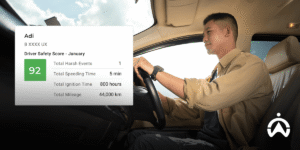
Whether your car rental business provides drivers or not, the driving behaviour monitoring function remains useful. A GPS tracker monitors driving behaviour and sends notifications when aggressive driving behaviour occurs, such as speeding, harsh braking, sharp cornering and harsh acceleration. The artificial intelligence (AI) in GPS tracking software can also assess drivers based on their driving behaviour, with the results presented in a Driving Score Report. This report can be used to evaluate and improve your car rental services. If your car rental business operates on a self-drive basis, driving behaviour monitoring can provide evidence in the event of an accident. You can replay the trip route from that day and obtain information such as whether the driver was speeding or braking harshly.

Calm car driver with a driving safety score display of 92

3. Monitor Rental Car Usage Levels

GPS tracking software helps you measure vehicle utilisation and identify cars that are rarely used or overused. From this data, you can determine which types of cars are the most or least popular. You can then make informed decisions about whether to reduce the fleet size, reduce or replace less popular car models, and adjust car rental allocations to achieve a better balance.

4. Manage Rental Car Service and Maintenance More Efficiently

    GPS tracking software includes a Reminders feature to help you manage fleet operations, including car servicing and maintenance, more efficiently. Synchronised with GPS tracker data, you can schedule car servicing based not only on the date, but also on the mileage and duration of each vehicle. Notifications can be set to be sent several kilometres in advance or at a specific time, allowing you time to process all necessary servicing for your rental car. Before renting out a car, you can check the service schedule to ensure it's in good condition when handed over to the customer.   

The advantages of a GPS tracker are also supported by its software, which provides various functions beyond location tracking, including geofencing, driving behaviour monitoring, route replay, automated reports and alerts, and schedule management. Therefore, it is important for car rental business owners to choose a GPS tracker with reliable software — Cartrack is one of the best in the world.

Cartrack also gives you the flexibility to take your car rental management to the next level. You can add features or sensors integrated with your vehicle’s GPS hardware or software, such as a fuel sensor, Communicator (a driver task assignment application developed by Cartrack), and Mi-Fleet (a fleet cost management feature in Cartrack’s software). Use Cartrack to improve service quality, vehicle productivity and the profitability of your car rental business. Contact us today!

7 Benefits of GPS Trackers for Company Fleet Drivers

The use of GPS trackers benefits not only management but also fleet drivers. As the frontline workforce, drivers need to understand this technology, as well as the concept of fleet digitalisation. By sharing a common perspective, management and drivers can collaborate to leverage this digital technology for optimal results. While the benefits of GPS trackers for management are clear, here are seven benefits for fleet drivers.

1. Improving Driving Safety

GPS trackers can monitor driving habits and send real-time notifications to drivers and operators when aggressive driving behaviours—such as speeding, harsh braking, rapid acceleration, and sharp cornering—are detected. Driving behaviour reports can also be downloaded and automatically emailed, enabling drivers to evaluate their driving style. Furthermore, these reports assist management in facilitating targeted training to improve driving safety.

2. Helps Ensure Asset Security During Transit

GPS trackers help drivers ensure the security of the cargo and vehicles they transport. GPS tracking companies typically offer various security devices that can be integrated into vehicle monitoring systems, such as remote immobilisers, panic buttons, surveillance cameras, and cargo door sensors. Drivers can send a distress signal to the operator during an emergency by pressing the panic button. Operators can remotely disable the engine starter using the immobiliser if surveillance cameras detect a vehicle theft. Additionally, operators can detect unauthorised opening or closing of cargo doors through the use of cargo door sensors.

3. Protecting Drivers from Unjustified Lawsuits

Data recorded by GPS trackers can serve as strong evidence in accident-related lawsuits or delivery claims, potentially exonerating drivers from wrongful accusations. Management can review vehicle trip history and surveillance footage from the day of the incident, while also accessing critical information such as vehicle speed, the time of the accident, driving duration, and the presence of aggressive driving behaviour. Regarding delivery claims—such as those involving lost or damaged goods—management can utilise data on aggressive driving, cargo door sensors, and temperature sensors (for food and beverage shipments).

4. Get a more objective job assessment

With GPS trackers, management can monitor driver productivity during trips, total working hours over a specific period, driving behavior, and the effectiveness of task completion. An additional "driver ID tag" feature helps identify the specific driver operating each vehicle. As the data reported by GPS trackers is highly accurate, driver performance assessments become more objective. Furthermore, the allocation of bonuses and other incentives to reward individual driver achievements can be determined based on this GPS tracking data.

Sopir armada sedang mengemudi truk dengan overlay data manfaat GPS tracker yang menampilkan statistik penggunaan kendaraan dan jarak tempuh.

5. Making Communication and Task Assignment More Efficient

GPS trackers reduce the frequency of calls or text messages to drivers—whether for routine location checks or dispatching—making it easier to assign the nearest driver to a destination and enabling more effective routing, as operators are notified of any deviations from the planned route. GPS trackers also facilitate the digitisation of task assignments through integrated features or applications, such as Cartrack’s Delivery solution. This digitisation helps drivers stay focused on the road and complete tasks more efficiently.

6. Reducing Document-Related Errors

Digitising job assignments frees drivers from the complexities of handling shipping paperwork and the risk of forgetting to carry necessary documents. Everything a driver needs is available within the assignment app, which is integrated with a GPS tracker. With Cartrack Delivery, assignments can include a series of sequential steps, ensuring drivers do not overlook any tasks. Proof of delivery—such as a photo or digital signature—can also be submitted directly through the Delivery app, offering a practical, efficient, and paperless solution.

7. Minimising loss of working time due to vehicle issues.

Operational vehicles must be kept in prime condition to prevent drivers from losing work time—and subsequently incurring overtime—due to breakdowns. GPS tracking software facilitates vehicle maintenance management; service schedules can be automatically set based on date, mileage, and the operational duration of each vehicle. Drivers can also report vehicle issues via the Driver Vehicle Inspection Report (DVIR) feature, which connects directly to the central fleet management system. These features aid in preventive maintenance and expedite the repair process, addressing issues before they lead to breakdowns and lost work time.

The benefits of implementing GPS trackers far outweigh any concerns fleet drivers might have about a perceived lack of freedom while working. GPS trackers help drivers work more safely, efficiently, and productively, while also protecting them from adverse situations. It is time to embrace the era of fleet digitalization with GPS tracking technology—ensure you use Cartrack’s reliable fleet management system. Click here for inquiries, orders, or to request a free online demo.